

New Hampshire · Unitedstates Authority
New Hampshire State Authority
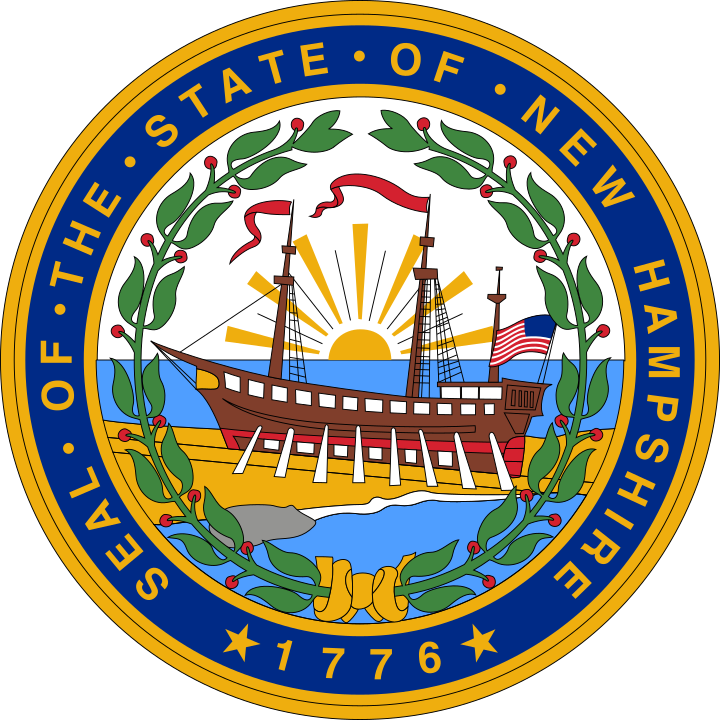
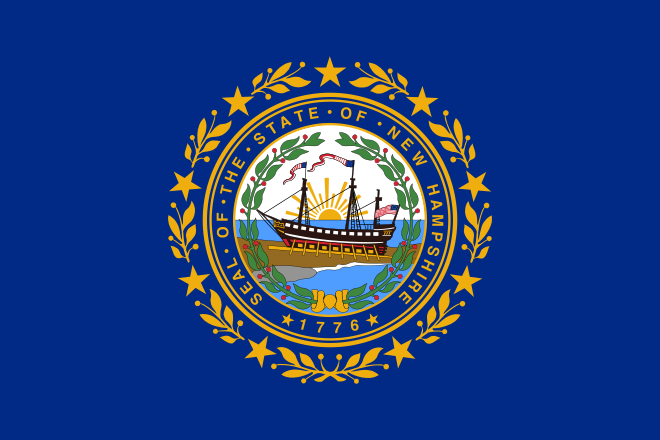
New Hampshire State Authority is home to 1,394,868 residents with median household income $99,031.
Explore New Hampshire State Authority by County
Click any county to visit its landing page.
New Hampshire State: What It Is and Why It Matters
New Hampshire is a small state with an outsized role in American civic life — 9,349 square miles of territory, 10 counties, and a governmental philosophy that has shaped national conversations about taxation, individual liberty, and local control for more than three centuries. This page covers the state's regulatory structure, jurisdictional boundaries, and the contexts in which New Hampshire's distinctive legal and political framework applies. The content library on this site spans more than 86 published pages, reaching from individual county governments to state agencies, regional economies, electoral law, and the specific statutory frameworks that govern daily life here.
Boundaries and exclusions
New Hampshire sits at the northeastern edge of the continental United States, bordered by Maine to the east, Vermont to the west, Massachusetts to the south, and the Canadian province of Quebec to the north. Its seacoast is the shortest of any U.S. state — 18 miles along the Atlantic — yet that strip anchors one of the state's most economically active regions.
The state's 10 counties divide the territory from the densely populated southeast to the sparsely settled North Country. Rockingham County anchors the southern coast and the Massachusetts border corridor, the most populous county in the state. Hillsborough County contains Manchester and Nashua, the two largest cities. Merrimack County holds the state capital, Concord. Strafford County covers the Dover-Rochester corridor in the southeast, while Belknap County and Carroll County define the Lakes Region and the southern White Mountains respectively.
Scope and coverage limitations: This authority covers matters within New Hampshire state jurisdiction — state statutes, state agency regulations, county and municipal government structures, and state constitutional provisions. Federal law as it applies to New Hampshire is addressed through the broader network; United States Authority serves as the national hub for federal regulatory frameworks. Matters governed exclusively by federal agencies — immigration, federal tax, interstate commerce regulation — are not covered here. Disputes or regulatory questions that cross state lines into Vermont, Maine, or Massachusetts fall outside this scope and require analysis under the law of the relevant bordering state.
The regulatory footprint
New Hampshire's regulatory architecture is deliberately compressed. The state has no broad-based personal income tax and no general sales tax — a statutory reality, not an accident, rooted in the so-called "New Hampshire Advantage" that state officials have defended through repeated legislative sessions. The primary tax mechanisms are the property tax, the Business Profits Tax, and the Business Enterprise Tax, administered by the New Hampshire Department of Revenue Administration under RSA Title V.
That minimalist tax posture does not mean minimal governance. The state runs 13 principal executive departments, a bicameral legislature known as the General Court — with 400 House members, the largest state legislative body in the United States by seat count (New Hampshire General Court) — and a five-member Executive Council that exercises an unusual confirmation and veto power over gubernatorial appointments and major contracts. No other state retains an executive council of this form.
Licensing and professional regulation sit across multiple agencies. The Office of Professional Licensure and Certification (OPLC) consolidated 51 licensing boards under a single administrative structure beginning in 2021, according to the OPLC's published organization records. Environmental permitting flows through the Department of Environmental Services. Insurance is regulated by the New Hampshire Insurance Department under RSA Title XXXVII.
The New Hampshire Government Authority provides dedicated reference coverage of the state's governmental structure, from the General Court and Governor's office to the county commission system. It is a practical starting point for understanding how state authority is organized before tracing any specific regulatory question down to its source agency.
What qualifies and what does not
New Hampshire state law applies to:
-
Residents — individuals domiciled in New Hampshire, subject to state statutes on property, family law, probate, and civil liability under RSA Title LVI and adjacent titles.
-
Businesses operating in-state — entities registered with the Secretary of State under RSA 293-A (business corporations) or RSA 304-C (LLCs), and subject to the Business Profits Tax on income derived from New Hampshire activity.
-
Real property within state borders — all land transactions, zoning disputes, and property tax assessments fall under New Hampshire jurisdiction regardless of the owner's domicile.
-
Professional licensees — any person practicing a state-licensed profession within New Hampshire borders, regardless of where they hold a primary license, must comply with New Hampshire licensing requirements.
-
State-chartered entities — banks, credit unions, and insurance carriers chartered in New Hampshire answer to the New Hampshire Banking Department and Insurance Department respectively.
New Hampshire state authority does not apply to:
-
Federally regulated activities (banking under OCC charter, federally licensed broadcast spectrum, federal firearms licensing)
-
Tribal lands under federal trust status
-
Activities conducted entirely outside the state by non-resident entities with no New Hampshire nexus
-
Interstate compacts where federal supremacy governs the outcome
The New Hampshire State: Frequently Asked Questions page addresses common boundary questions — including what triggers New Hampshire tax nexus for out-of-state businesses and which professional licenses transfer under reciprocity agreements.
Primary applications and contexts
New Hampshire's governmental framework shows up in three recurring contexts that distinguish it from neighboring states.
Local government primacy. The town meeting form of government — where registered voters gather to debate and approve municipal budgets line by line — remains legally operative in most of New Hampshire's 221 incorporated towns. This is not ceremonial. Towns with populations under the optional town manager threshold operate under selectboard governance, making the local level the first meaningful point of regulatory contact for residents dealing with zoning, road maintenance, and school funding. Hillsborough County's smaller towns still run annual deliberative sessions under RSA 40:13.
The property tax structure. Because the state lacks a sales or income tax, New Hampshire's property tax burden ranks among the highest in the nation. The New Hampshire Supreme Court's Claremont decisions (1993 and 1997) established that the state has a constitutional obligation to fund an adequate education — a ruling that restructured how property tax revenue flows between wealthy and low-wealth districts. The tension between local property tax control and state education funding obligations remains one of the most litigated areas of New Hampshire public law.
Electoral significance. New Hampshire's status as the first presidential primary state is protected by RSA 653:9, which directs the Secretary of State to schedule the primary at least seven days before any similar contest. This is a specific statutory mechanism, not tradition alone. The practical consequence is that presidential campaigns maintain sustained organizational presences in the state — particularly in Hillsborough and Rockingham counties — for extended periods before each election cycle.
These three contexts — hyper-local governance, property-tax-centric finance, and early electoral influence — shape the practical meaning of "New Hampshire state" for anyone navigating its public systems, and they run through nearly every topic covered across this site's 86 published pages.
New Hampshire Counties — Interactive Map
Click any county to view its full reference page.
New Hampshire county map
Browse Counties
- Rockingham County (12,307)
- Strafford County (12,060)
- Hillsborough County (7,105)
- Belknap County (3,169)
- Grafton County (2,157)
- Coos County (1,438)
- Cheshire County (925)
- Sullivan County (237)
- Carroll County (127)
- Merrimack County (102)